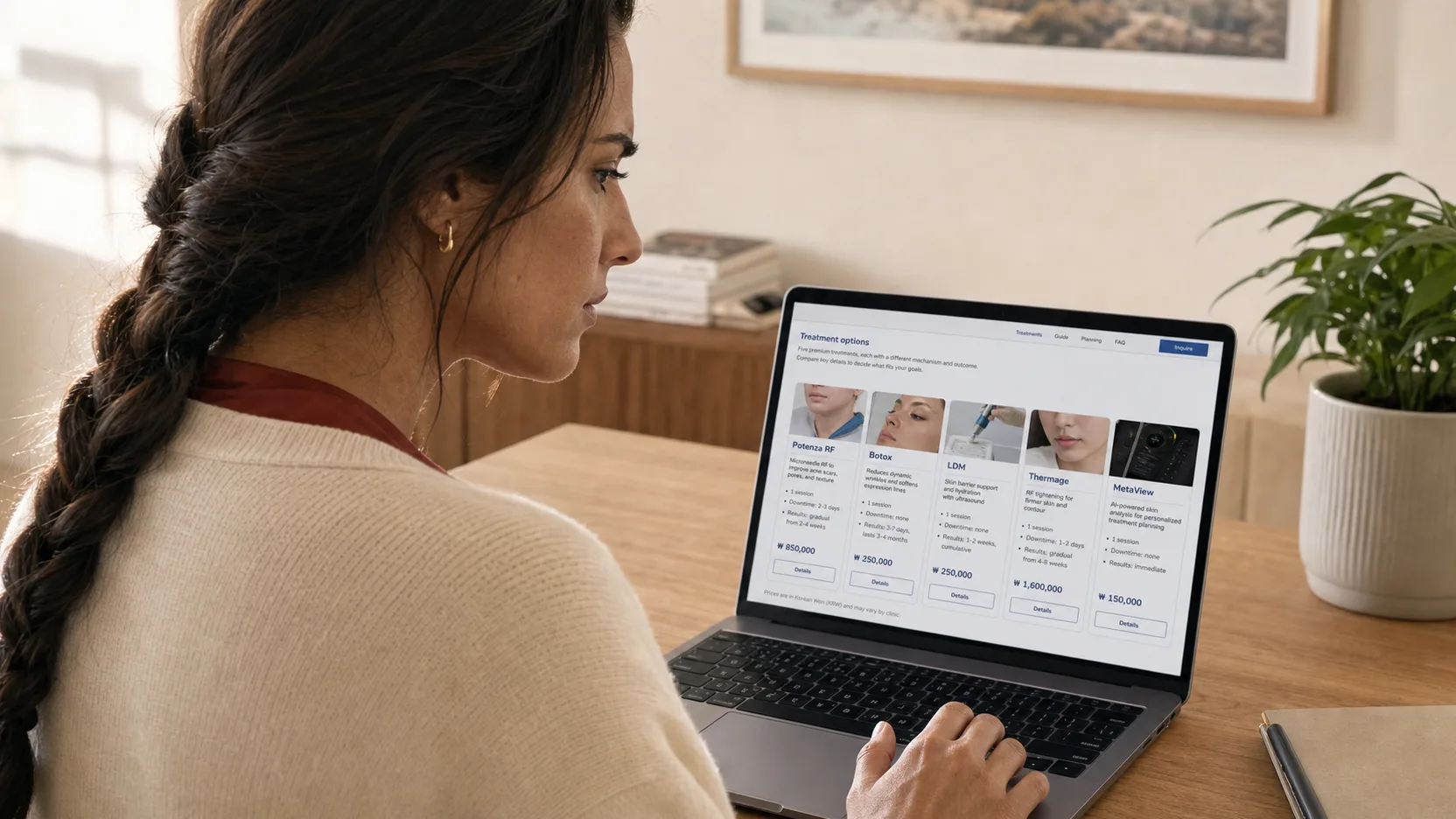
If you are visiting Korea and looking at premium skincare menus, it is easy to feel that every popular treatment promises the same thing. Firmer, smoother, brighter skin with little interruption to your trip. My honest advice is to slow down enough to understand what each treatment is trying to improve, because “top-tier” should mean a thoughtful match for your skin and goals, not the most expensive option.
These five are the S+ grade treatments from my original guide, options people often consider when they want advanced technology, relatively manageable recovery, and results that may develop over time. They are not interchangeable, and a consultation should clarify whether a treatment suits your concerns, skin condition, and travel schedule.
1. Could Potenza RF microneedling be the right balance of texture and firmness?
Potenza combines microneedling with radiofrequency energy. People commonly consider it when texture, fine lines, pores, or a loss of firmness are all part of the conversation, because the treatment is designed to support collagen and elastin stimulation beneath the skin’s surface. Some people notice an early firm-looking effect, while texture and tone changes are usually something to assess gradually rather than overnight.
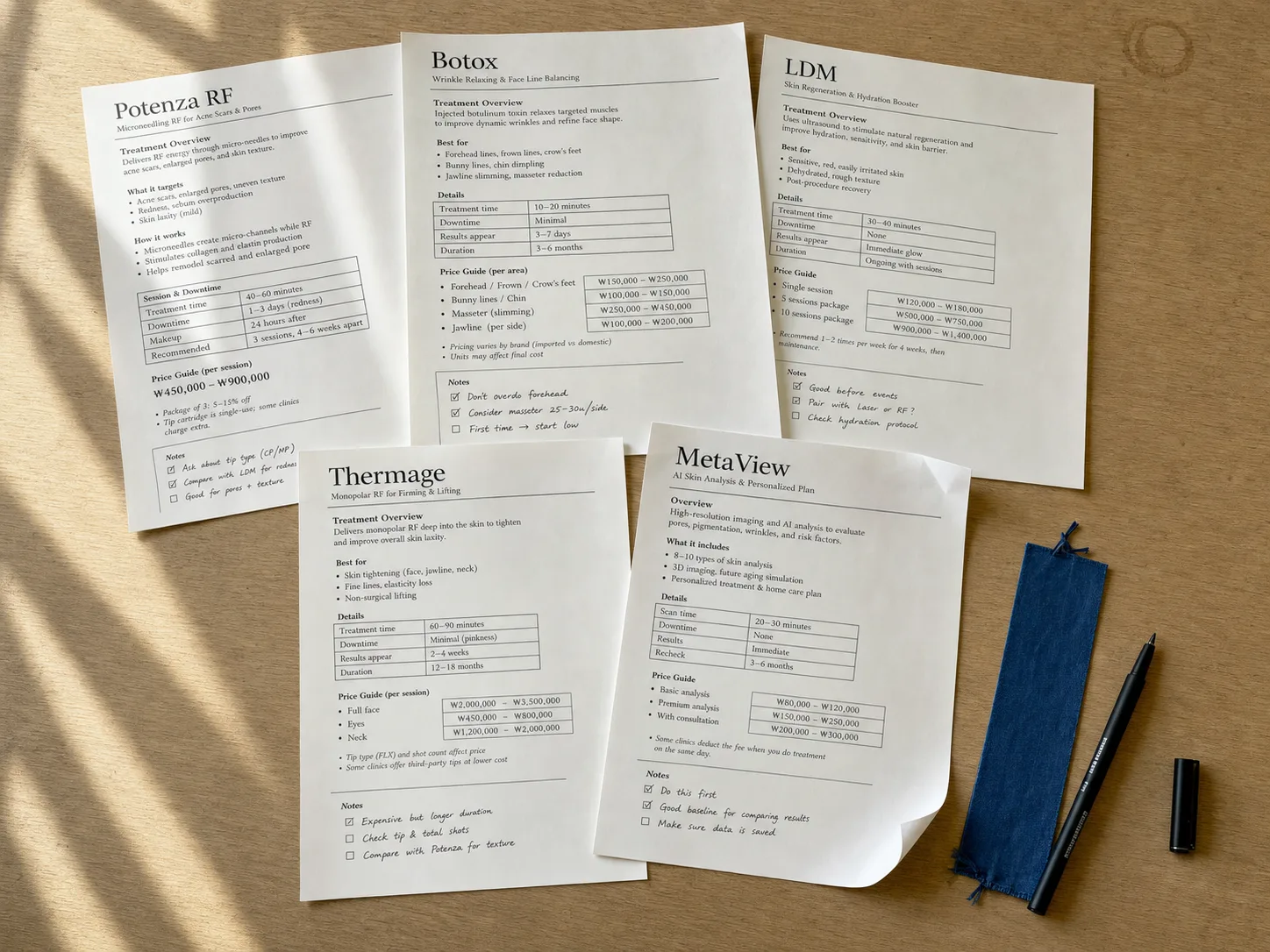
The sensation is often described as low to moderate discomfort, with warmth during treatment. A session is typically ₩500,000–₩1,000,000 (about $400–$800). Recovery is often limited compared with more intensive resurfacing treatments, but redness, sensitivity, or small marks can still matter if you have photos, flights, or an important event immediately afterward.
2. Is Botox about wrinkle prevention, facial contouring, or both?
Botox is often discussed for expression lines and, in some cases, jawline contouring. The injections themselves are quick and usually mildly uncomfortable, which is one reason it is popular with visitors who have limited time. The important part is being specific about your goal. Softening movement-related lines is a different conversation from changing the appearance of a strong jaw muscle.
A session is generally ₩250,000–₩400,000 (about $200–$320). Results can look subtle when the plan fits the person’s facial movement and muscle strength, but the effect is not instant, and the outcome can vary. I would not treat it as a casual add-on because it seems quick; placement, dose, and your preferences for movement are worth discussing carefully.
3. When does LDM make more sense than an energy-based treatment?
LDM is often chosen by people who want an overall skin-rejuvenation experience with low discomfort and no expected disruption to their day. It is commonly associated with improving the look and feel of skin texture, tone, and elasticity, and many people find the appointment relaxing. A session is usually ₩300,000–₩500,000 (about $240–$400).
Compared with Potenza or Thermage, LDM is not usually the treatment people choose for a dramatic lifting goal. I think of it more as a gentler option for someone focused on overall skin condition. Even when a treatment feels mild, ask whether your current skin sensitivity, active irritation, or recent procedures change the timing.
4. What should you realistically expect from Thermage?

Thermage uses radiofrequency for tightening and a non-surgical lifting-focused approach. It is often considered for the face or body when someone wants to support a more contoured appearance without surgery. The experience can be moderately uncomfortable because of the heat sensation, and the cost reflects its premium positioning at ₩1,000,000–₩2,500,000 (about $800–$2,000) per session.
This is the treatment I would be especially careful not to book because a package sounds impressive. The visible change may be gradual as collagen is stimulated, and it should not be framed as a substitute for every concern that surgery addresses. Ask what area is being treated, what kind of improvement is realistic for that area, and whether combining it with other treatments is necessary.
5. Why can MetaView skin analysis be a useful first step?
MetaView is different from the other four because it is a skin-analysis appointment rather than a treatment intended to change your skin directly. There is no pain, and it can help turn a vague request such as “I want better skin” into a more focused discussion about what the clinic sees and what they propose next. The usual price range is ₩150,000–₩300,000 (about $120–$240).
For me, its value is in asking better questions before spending on future treatments. A skin analysis can inform a tailored plan, but it should not pressure you into immediately buying everything that appears on that plan. Take time to understand the reasoning behind each recommendation.
What should I ask during the consultation?
Ask, “What concern is this treatment meant to address in my case, and what change should I realistically expect?” Then ask about discomfort, recovery, possible reactions, and how the treatment fits with anything else you recently had done.
How do I decide what is truly S+ grade for me?
Ask, “Why is this option a better match than the alternatives?” Premium technology can be useful, but the best decision is usually the one that respects your goals, budget, skin condition, and timeline rather than chasing a label.
My S+ grade means these are well-known premium options worth understanding, not that everyone needs all five. If you go into a Korea consultation informed and unhurried, you give yourself much more room to choose with confidence.
Kim
How much does Potenza RF microneedling cost in Korea?
A session is typically priced around 500,000 to 1,000,000 won, roughly $400 to $800 USD. It combines microneedling with radiofrequency to support collagen and elastin beneath the skin’s surface, with results assessed gradually rather than overnight.
What is MetaView skin analysis and how much does it cost?
MetaView is a skin-analysis appointment rather than a treatment, priced around 150,000 to 300,000 won, roughly $120 to $240 USD. It can turn a vague goal like wanting better skin into a more focused discussion about what a clinic recommends next.